Show summary Hide summary
- Why Townfall marks a new chapter for Silent Hill
- St. Amelia: a town built from decline and salt air
- The cast and character issues
- How Townfall plays: tools, stealth, and the CRT mechanic
- Puzzles and exploration balance
- Presentation: visuals, sound, and PS5 performance
- Who should pick up Silent Hill: Townfall
Silent Hill feels different again. Konami and developer Screen Burn Interactive have taken the series out of its classic namesake town and reimagined it as a globe-trotting anthology. Their latest entry moves the camera to the first person and plants players in a foggy Scottish fishing village where mood and mechanics matter more than returning faces.
Why Townfall marks a new chapter for Silent Hill
Townfall continues Konami’s recent pivot: treat Silent Hill as a series of mood pieces rather than a single, ongoing narrative. After a small experimental release and the acclaimed Silent Hill 2 remake, the franchise expanded into standalone tales.
Nas slams music industry over disrespect: teases new music, vows to address it
1992 vocal performances: 3 jaw-dropping moments that still amaze
- The Short Message — a limited free project that tested new approaches.
- Silent Hill 2 Remake — a successful reimagining that raised expectations.
- Silent Hill f — an entry set in 1960s Japan that leaned into period atmosphere.
- Silent Hill: Townfall — set in 1996 Scotland and built for first-person play.
That anthology model gives Screen Burn freedom to chase tone over continuity. Townfall is less about franchise lore and more about crafting unease through place, sound, and limited resources.
St. Amelia: a town built from decline and salt air
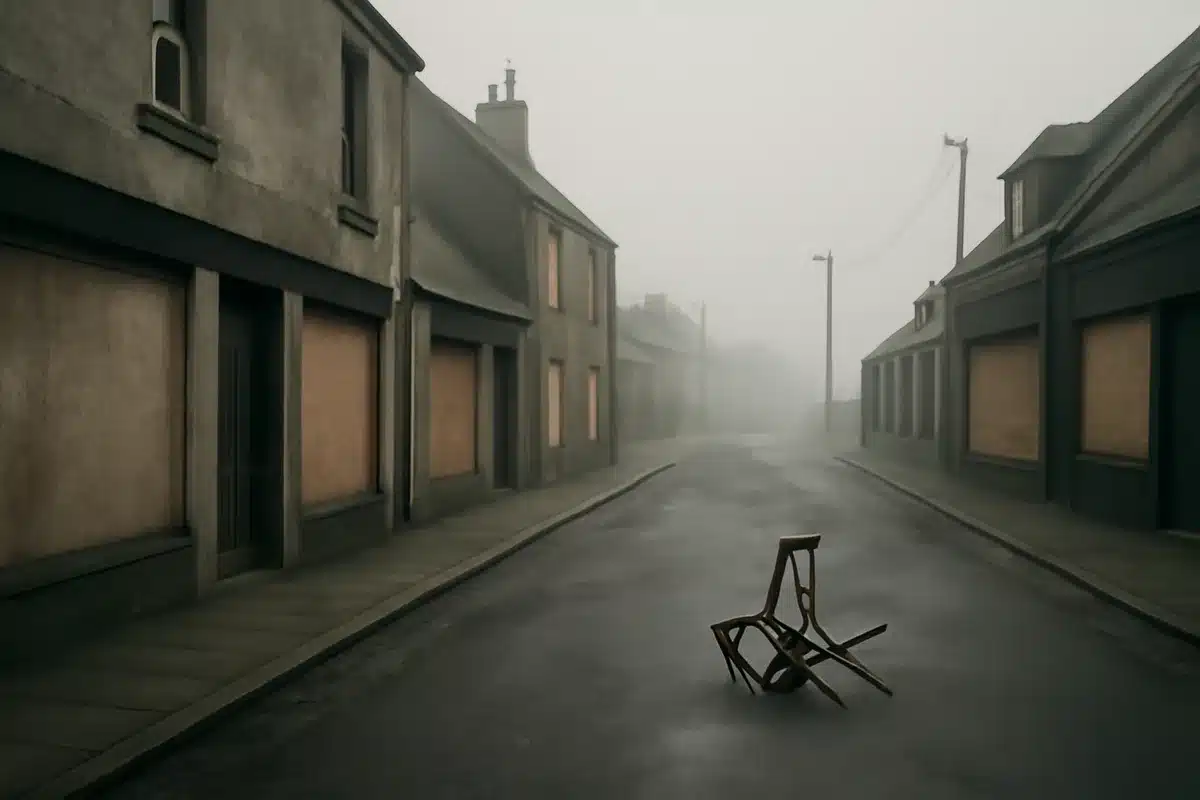
The village of St. Amelia is the game’s real lead. Inspired by Fife’s coastal settlements, the town feels hollowed out. Empty shopfronts, boarded houses, and a mural remembering a community’s loss suggest an economic collapse beneath supernatural events.

Townfall leans into political and social decay. The screenplay folds in consequences of industrial change and corporate greed. The result is a setting that feels lived-in and ominous at once.
The environment carries more weight than many characters. Exploration reveals shards of story in everyday places: a tipped chair, a child’s drawing, a shop ledger. These small details often speak louder than dialogue.
The cast and character issues
You play mainly as Simon Ordell, an African American man who washes ashore in St. Amelia for reasons the game teases out slowly. For parts of the story you also control Zoe Ellis, a local nurse coping with trauma after a mass casualty event.
Both characters serve the mystery, but they rarely transcend it. Simon is driven by questions more than personality. Zoe is quiet, weighed down by guilt. Richard, a mysterious contact, nudges Simon along.
Critiques worth noting:
- Simon’s characterization can feel muted. His motivations are clear, but his voice is understated.
- Costume design sometimes clashes with the era; a modern aesthetic crops up in odd places.
- Environmental storytelling outperforms much of the written dialogue.
How Townfall plays: tools, stealth, and the CRT mechanic
Townfall is a stealth-first survival horror title. Combat is risky and resources are scarce. The game favors avoidance and careful observation.

Signature mechanics that shape tension
- CRT monitor: Simon carries a small CRT screen that detects enemies. It shows silhouettes on a red field, letting you see threats through walls. You can lock onto targets, but only one at a time, and you must retune the frequency as new threats appear.
- Pager for Zoe: Zoe’s device gives directional alerts rather than full images. It’s louder and designed to startle, fitting her role as a nurse who needs quick warnings.
- Diegetic saves: You save by dialing a landline. Entering 1-0-0 on a phone opens the save menu. It slows pacing, but deepens immersion.
Weapons, enemies, and inventory design
Combat options are limited and brittle. Common weapons include a wooden plank and a lead pipe that degrade with use. Firearms are rare — the revolver is common for most of the game, while a flare gun and a double-barrel shotgun appear late.
- Enemy roster is concise: two core types of shambling, burn-scarred corpses, and a persistent stalker in certain Otherworld sequences.
- One variant charges quickly with an embedded axe. Another attacks at range with improvised needles.
- Ammo is intentionally scarce. Supplies are placed logically: household medicine in homes, melee tools in gardens, heavier metal weapons in industrial areas.
Using firearms often makes situations worse by attracting nearby foes. At higher difficulty, even flashlight beams can trigger enemies. That design choice increases anxiety, though it occasionally feels inconsistent when blind creatures “see.”
Puzzles and exploration balance
Puzzle design is mixed. Zoe’s hospital sequence offers satisfying challenges. Simon’s puzzle segments sometimes fall into tedious fetch quests split across large areas.
The game shines when you’re in the Shorefront early sections. Those moments combine atmospheric exploration with environmental clues that reward attention. By contrast, extended Otherworld sections can mute that discovery and lean too heavily on backtracking.
Playtime varies by approach. A first run took around 15–16 hours for a cautious player. Speedier runs can drop to six hours or less. Like several Silent Hill titles, playing multiple times unlocks alternate endings, and some paths require obscure actions to reveal.
Presentation: visuals, sound, and PS5 performance
On PlayStation 5, Townfall runs smoothly. Performance Mode provides a stable frame rate while keeping strong visuals. Lighting work and fog effects are highlights; the village glows with moody, weathered detail.
Screen Burn uses cinematic devices sparingly. Black bars can be toggled off; some players will prefer a full-screen view for long sessions.
The soundtrack, produced by Pilotpriest, leans on atmospheric synth. It often feels nostalgic and eerie, skirting the series’ industrial past for a more dreamlike electronic palette.
Diegetic interfaces — dialing phones, typing on computers, and using the CRT or pager — are core to the experience. These touches keep interactions grounded and underscore the game’s focus on immersion.
Who should pick up Silent Hill: Townfall
If you enjoy modern, slow-burn survival horror, Townfall delivers. The atmosphere, stealth mechanics, and set pieces are strong. Expect tension more than shock, and exploration over action.
Buyers seeking franchise continuity or classic Silent Hill canon should lower expectations. Townfall is a standalone story that borrows series motifs rather than narrative threads.
Silent Hill: Townfall is available for pre-order on PS5 and launches on Sept. 24.