
Show summary Hide summary
- Weir’s core belief: science, patience and partnership
- How the film opens: waking on a ship with no memory
- An alien ally: Rocky and the movie’s heart
- Balancing comedy and scientific rigor on screen
- Why the story resists turning into pure gag-driven comedy
- What Project Hail Mary asks of its audience
- Performances, design and the film’s pacing
- From science teacher to reluctant savior
Andy Weir’s Project Hail Mary lands on screens as a hopeful, brainy space adventure. The film leans on curiosity, careful problem-solving, and an oddball friendship to turn cosmic stakes into human drama. It’s a movie that trusts science and finds warmth in collaboration, and that trust is its most persuasive trick.
Weir’s core belief: science, patience and partnership
Andy Weir built his fiction around a simple idea: complex natural problems yield to steady minds working together. That premise fuels both Project Hail Mary and The Martian. In both works, solitude is real. Yet the solutions come from methodical thinking, accumulated knowledge and the willingness to seek help.
Nas slams music industry over disrespect: teases new music, vows to address it
1992 vocal performances: 3 jaw-dropping moments that still amaze
- Knowledge matters: facts and skill solve technical dead ends.
- Patience matters: progress often arrives one small step at a time.
- Collaboration matters: even the loneliest hero needs allies.
Framed this way, the story is not a fantasy of heroics. It is an argument for steady competence, and for the social bonds that make competence useful.
How the film opens: waking on a ship with no memory
Ryan Gosling plays Ryland Grace, a former middle school teacher with a science background. He awakens aboard a spacecraft with gaps in his memory and a mission he cannot immediately recall. Flashbacks gradually reveal a last-resort plan organized by Eva Stratt, a driven coordinator played by Sandra Hüller.
The central crisis is cosmic: a mysterious agent is dimming stars, threatening life across the galaxy. Grace’s role is practical and urgent. He must identify the threat and discover how to stop it before it extinguishes the sun.
An alien ally: Rocky and the movie’s heart
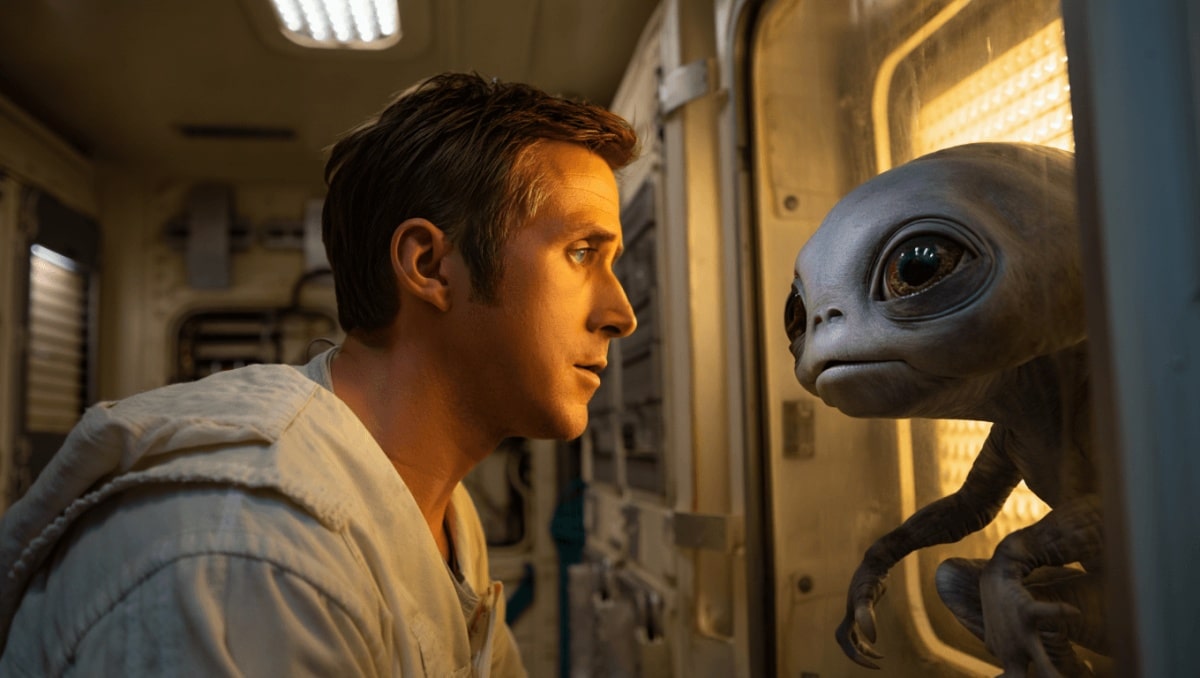
When Grace encounters another intelligence, the film shifts from isolation drama to a cross-species friendship. The alien engineer he meets is nicknamed “Rocky” for his stony appearance. Rocky is more than comic relief. He is a fellow scientist with technical skill and personal grief.
Their relationship evolves into a partnership that balances humor and poignancy. James Ortiz supplies Rocky’s voice and puppetry, giving the character an expressive, unexpected warmth.
- Rocky brings technical expertise and unique problem-solving approaches.
- The exchange of ideas becomes the emotional center of the story.
- Their bond reframes loneliness as something solvable by friendship.
The film uses that friendship to explore why company matters more than bravado in the face of disaster.
Balancing comedy and scientific rigor on screen
Directors Phil Lord and Christopher Miller shape the movie with a light touch. Screenwriter Drew Goddard preserves Weir’s appetite for detail. The result is a film that can deliver both laughs and credible technical problem-solving.
Gosling’s performance underplays the heroics. He conveys quiet intelligence and a survivor’s stubbornness. At times the humor lands as warm buddy comedy. At others, the film leans into tension and the ethical weight of a mission to save multiple worlds.
How the filmmakers keep science grounded
Rather than simplifying every concept, the movie trusts audiences to follow experiments and engineering work. Exposition is woven into character moments. That makes the technical solutions feel earned, not just convenient plot devices.
Why the story resists turning into pure gag-driven comedy
Rocky’s cuteness could have collapsed the film into slapstick. Instead, the filmmakers and cast preserve emotional stakes. Jokes arrive, but they sit alongside genuine moments of doubt, planning and sacrifice. This mix helps the film avoid feeling shallow.
The emotional payoff comes from seeing two intelligent beings rely on one another to face an existential threat.
What Project Hail Mary asks of its audience
The movie invites viewers to consider how people cope when the odds are against them. It highlights three themes:
- Practical intelligence beats theatrics.
- Companionship can be lifesaving.
- Persistent curiosity unlocks solutions.
These are not grand philosophical pronouncements. They are simple, repeatable lessons delivered through character choices and problem-solving scenes.
Performances, design and the film’s pacing
The production design sells the claustrophobic, workaday reality of a one-person ship. The pacing alternates brisk fixes with slower, reflective beats. That rhythm mirrors the novel’s insistence on incremental progress.
Supporting performances and the technical craft of puppetry and voice work add texture. Rocky’s physicality and speech are carefully matched to convey intelligence across species barriers.
From science teacher to reluctant savior
At its center, the story tracks a man who must transform expertise into action. Grace is not an invincible hero. He improvises, learns, and adapts. Those qualities, rather than feats of courage alone, enable survival.
This film argues that in the vastness of space, calm minds and cooperative hands are what matter most.










