
Show summary Hide summary
- Design, weight and real-world portability
- Ultra-quiet operation and fast recharge
- Ports, power output and battery chemistry
- What changed from the original Power 1000
- Expansion capability and accessories that matter
- Why drone pilots will notice this unit
- Shortcomings to consider
- Price context and target users
DJI is no longer just the drone company most people know. The firm quietly branched into portable power, producing compact stations that appeal to creators, campers, and anyone who needs reliable energy off-grid.
Design, weight and real-world portability
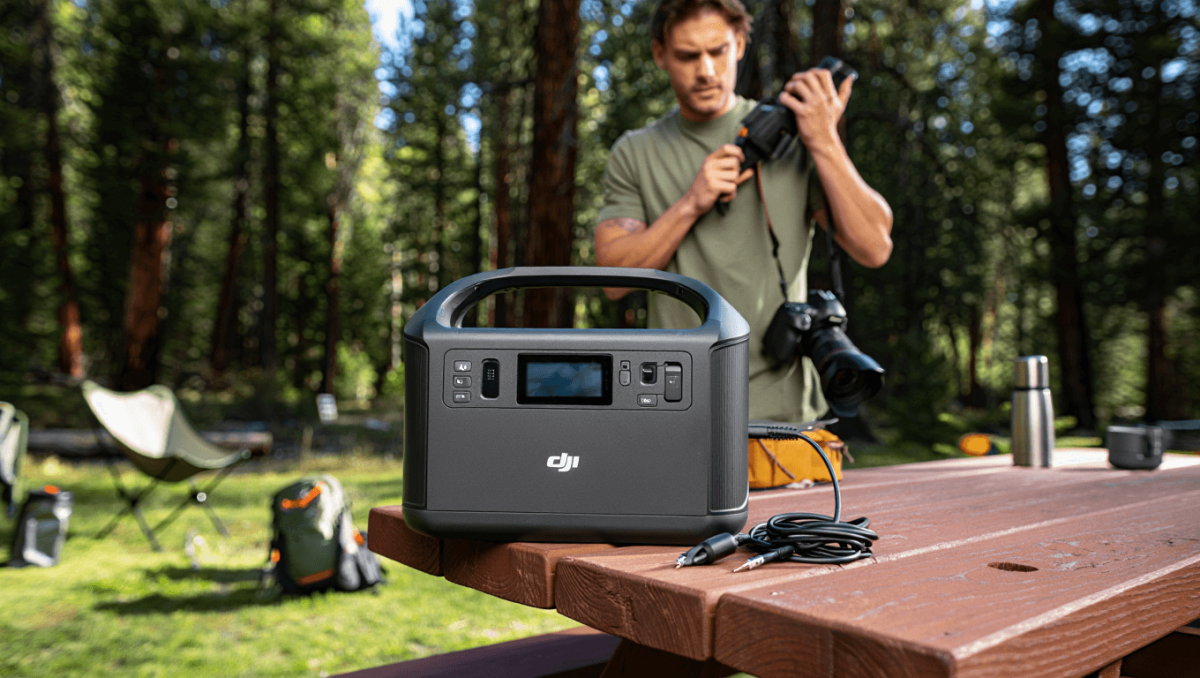
The Power 1000 V2 blends a refined look with practical ergonomics. It holds 1,024Wh in a chassis that remains manageable. At about 31 pounds, it’s lighter than many 1kWh rivals. Dual side handles make lifting and loading easier.
Nas slams music industry over disrespect: teases new music, vows to address it
1992 vocal performances: 3 jaw-dropping moments that still amaze
- Dimensions: 17.6 in × 8.9 in × 9 in
- Weight: ~31 pounds
- Includes a protective bag that lets you access ports without removing the unit
That combination matters. You can move it across a campsite, carry it up stairs, or place it near a shoot without too much hassle.
Ultra-quiet operation and fast recharge
Noise level is a standout. DJI rates the unit at about 26 decibels. That level keeps fans out of the audio mix when filming.
Charging speed is another highlight. From empty to full on household power takes 56 minutes. Hitting 80 percent requires roughly 37 minutes. Those numbers reduce downtime between shoots or during outages.
Ports, power output and battery chemistry
Essential specs at a glance
- Capacity: 1,024Wh
- Continuous output: 2,600W
- AC outlets: 4
- USB-C: 2 × 140W
- USB-A: 2
- SDC ports: 1 SDC, 1 SDC Lite
- Battery type: LiFePO4 (lithium iron phosphate)
- Cycle life: ~80% capacity after 4,000 cycles
- Recharging methods: AC, solar, car
- Operating temp: 14°F to 113°F; recharge temp: 32°F to 113°F
These connections aim to cover cameras, laptops, phones, and small appliances. The LiFePO4 chemistry prioritizes longevity and safety.
What changed from the original Power 1000
The V2 improves key practical points. DJI focused on ports, output, altitude tolerance, and charging speed.
- More AC outlets: The V2 offers four AC sockets versus two on the first model.
- Higher continuous output: 2,600W on the V2, up from 2,200W before. That’s roughly an 18% increase.
- Faster recharge: Full recharge drops from about 70 minutes to 56 minutes.
- Higher altitude operation: The V2 works up to 5,000 meters, compared to 3,000 meters previously.
These upgrades make the V2 more flexible for creators shooting in remote locations or running heavier gear.
Expansion capability and accessories that matter
The Power 1000 V2 scales. You can attach up to five DJI Expansion Battery 2000 units. Each adds 2,048Wh. With five attached, total stored energy reaches 11,264 Wh.
- Expansion battery price: about $899 each
- Optional hand truck combo for moving stacked batteries
- Protective storage bag with cable compartment
This modular approach lets buyers start small and add capacity later. DJI’s carrying solutions make large setups more practical in the field.
Why drone pilots will notice this unit
DJI includes two SDC ports that are tuned for fast drone battery charging. That integration is rare among third-party stations.
- Inspire 3 TB51: charges 10% → 95% in about 28 minutes using the right cable.
- Air Series 3: reaches 95% in about 30 minutes.
To use these speeds you need DJI’s fast-charge cable. It costs around $20. For professionals juggling multiple drone batteries, the time savings add up.
Shortcomings to consider
The V2 has a few trade-offs. Some are design choices that may affect off-grid users.
- No built-in solar input port. You must buy the DJI Power Solar Panel Adapter Module, roughly $59, to hook panels up.
- It lacks an onboard flashlight or work light. That feature is helpful during outages or when shuttling gear at night.
- Some competitors offer more AC outlets. For instance, an Anker companion model provides five AC sockets.
If solar integration or an inbuilt light matters, factor those gaps into a buying decision.
Price context and target users
DJI lists the Power 1000 V2 at about $699. That price sits within the common range for 1kWh class stations.
- Strong fit for content creators who need quiet operation on set.
- Useful for campers and road-trippers seeking a mid-size battery.
- Expandable for professionals who might later add thousands of watt-hours.
Consider noise, recharge speed, and drone-specific fast charging when weighing this model against rivals.










