
Show summary Hide summary
- What eyewitnesses actually recorded about the 1621 meal
- How turkey became linked to Thanksgiving dinner
- The 19th-century push that turned Thanksgiving into a national ritual
- How industrial food systems and marketing shaped Thanksgiving menus
- Social rituals, spectacle, and the turkey’s image
- Why side dishes and desserts became crucial
- How much turkey do Americans eat on Thanksgiving?
- Why Thanksgiving remains flexible and widely embraced
Most of us learned a tidy story about Thanksgiving in school: children in paper headdresses, Pilgrims in buckled hats, and a warm table piled with turkey. That tidy image hides the messier truth. Early accounts of the 1621 gathering focus more on diplomacy and venison than on a roasted turkey centerpiece. The holiday we know evolved over centuries, shaped by politics, marketing, and shifting food systems.
What eyewitnesses actually recorded about the 1621 meal
Surviving firsthand notes about the first Thanksgiving are scarce. When historians examine those documents, the menu is barely described. What stands out is the mention of deer brought by the Native allies.
Nas slams music industry over disrespect: teases new music, vows to address it
1992 vocal performances: 3 jaw-dropping moments that still amaze
- Venison is the only meat clearly recorded by eyewitnesses from that event.
- The accounts emphasize alliance-building between the Wampanoag and English colonists.
- Simple harvest foods would have been common, but precise details are missing.
How turkey became linked to Thanksgiving dinner
Turkey was not a guaranteed dish at the earliest celebrations. Over time, several practical and cultural forces nudged it into the Thanksgiving spotlight.
- Turkeys are large and can feed many people.
- They were plentiful in northeastern forests and thus affordable.
- Industrial-scale food production made turkey easier to supply nationwide.
- Commercial promotion encouraged turkey as the obvious centerpiece.
Practical advantages of the bird
Wild turkeys were common across much of colonial New England. Their size made them a sensible choice for communal meals. As farming and transport improved, turkey became a predictable and accessible option for large family gatherings.
The 19th-century push that turned Thanksgiving into a national ritual
The holiday’s national profile rose in the 1800s. Before that, many states observed their own dates for harvest celebrations. A sustained campaign by a notable magazine editor helped unify the practice.
Sarah Josepha Hale, a prominent writer and magazine editor, lobbied for a national day of thanks. She published essays, letters, and editorials that argued for a holiday focused on home, family, and national unity. Her push gained momentum during a period of deep division in the United States.
- Her campaign emphasized family values and reconciliation.
- In 1863, during the Civil War, President Abraham Lincoln proclaimed a national Thanksgiving.
- The federal recognition helped standardize the holiday across states.
How industrial food systems and marketing shaped Thanksgiving menus
The rise of mass food production in the late 19th and early 20th centuries changed what Americans ate. Food companies and retailers promoted specific dishes to boost sales. That marketing left a lasting imprint on holiday plates.
- Food companies pushed recipes that used their products, like canned pumpkin and evaporated milk.
- During economic hardship, families stretched meat with inexpensive sides and casseroles.
- Retailers used Thanksgiving as a launch point for winter shopping.
Examples of commercial influence
- Libby’s and other brands popularized pumpkin pie recipes to sell canned goods.
- The green bean casserole emerged from corporate recipe promotion in the 20th century.
- Cranberry sauce became common despite fresh cranberries’ tartness, thanks to sugar and processing.
Social rituals, spectacle, and the turkey’s image
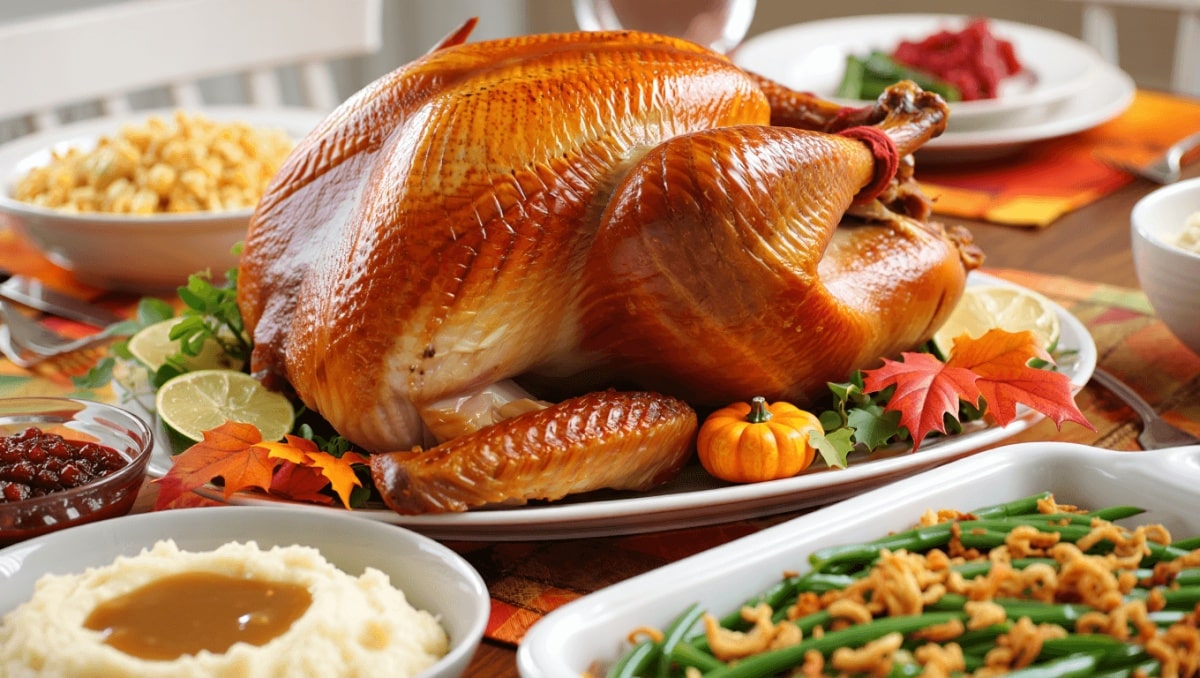
Beyond taste and supply, visual spectacle reinforced the turkey’s place at the table. A golden roasted bird is an impressive showpiece.
Department stores and parades also linked Thanksgiving to consumption. A major retailer’s parade in New York turned the holiday into a commercial kickoff for the holiday season.
- Big turkeys make a dramatic focal point at family meals.
- Retail and media events tied Thanksgiving to holiday shopping.
- Over time, the turkey became shorthand for the entire holiday experience.
Why side dishes and desserts became crucial
Economic pressures influenced recipes. During the Great Depression, meat could be costly. Households adapted by emphasizing sides that were inexpensive yet filling.
- Stuffing uses bread to bulk up the meal.
- Pumpkin pie and other desserts were easy to mass-produce and market.
- Casseroles and inexpensive vegetables helped stretch limited protein.
How much turkey do Americans eat on Thanksgiving?
Holiday consumption statistics show the bird’s dominance. Government data indicate a substantial share of annual turkey consumption happens on Thanksgiving.
Roughly one in five turkeys raised for food are eaten on Thanksgiving Day, according to government reports. That concentration of consumption reinforces the cultural loop: turkey equals Thanksgiving.
Why Thanksgiving remains flexible and widely embraced
The holiday’s power comes from its adaptability. It functions as a secular time to gather, share food, and mark the changing seasons. No single religious or ethnic framework defines it.
People of many backgrounds can make Thanksgiving their own. Whether the menu centers on turkey, fish, or vegetarian options, the social ritual—coming together to eat and connect—remains the core.










