
Show summary Hide summary
- How the film stages a sudden nuclear threat
- Experts on realism: why the lone-warhead scenario raises doubts
- Missile-defense scenes: plausible details and cinematic shortcuts
- The command-and-control scenes that rang true
- Human details: rule-bending under stress
- Missed options: a presidential choice the movie sidesteps
- Timing and context: why the film matters now
- Where experts found value in the drama
In Kathryn Bigelow’s new film A House of Dynamite, a single nuclear warhead appears on screens and the United States has less than 30 minutes to respond. The movie follows presidents, generals and staff as they scramble in near real time. It forces viewers to watch how decisions would be made under unimaginable pressure.
How the film stages a sudden nuclear threat
The drama opens with what looks like a bolt from the blue: one missile launched from the Pacific aimed at the U.S. mainland. The clock runs down and the audience rides the wave of urgent calls, briefings and split-second options.
Nas slams music industry over disrespect: teases new music, vows to address it
1992 vocal performances: 3 jaw-dropping moments that still amaze
- Most action stays inside command centers and video calls.
- Characters face the practical and moral dilemmas of retaliation.
- The film leans on tension, procedure and the weight of responsibility.
Experts on realism: why the lone-warhead scenario raises doubts
Several nuclear scholars say the notion that a single warhead would arrive unannounced is unlikely. They argue nuclear conflict usually grows out of a conventional crisis, not from a solitary, unexplained launch.
Escalation, not out-of-the-blue strikes
Specialists note that modern nuclear danger most often stems from an unfolding crisis that escalates. A surprise, isolated missile aimed at a major city would be a strange and risky tactic for any nuclear-armed state.
No serious actor would typically fire just one warhead if they wanted to blunt an opponent’s ability to respond, experts say. Multiple warheads, decoys or coordinated salvos are more likely methods in reality.
Missile-defense scenes: plausible details and cinematic shortcuts
The movie shows Fort Greely in Alaska scrambling interceptors as the warhead arcs toward the heartland. Two intercept attempts fail on screen, creating dramatic tension.
What defense analysts liked
- Interceptors malfunctioning or missing is a documented risk.
- Single-interceptor success rates leave room for failure.
What they disagreed with
- In reality, operators would likely fire more than two interceptors at a single threat.
- Modern doctrine usually assigns multiple interceptors to improve hit probability.
- Missile defenses struggle against dozens or hundreds of incoming objects, not lone missiles.
Analysts add that evolving weapons—multiple independent reentry vehicles, decoys or novel delivery systems—could reduce the chance that even a beefed-up shield would stop a massive strike.
The command-and-control scenes that rang true
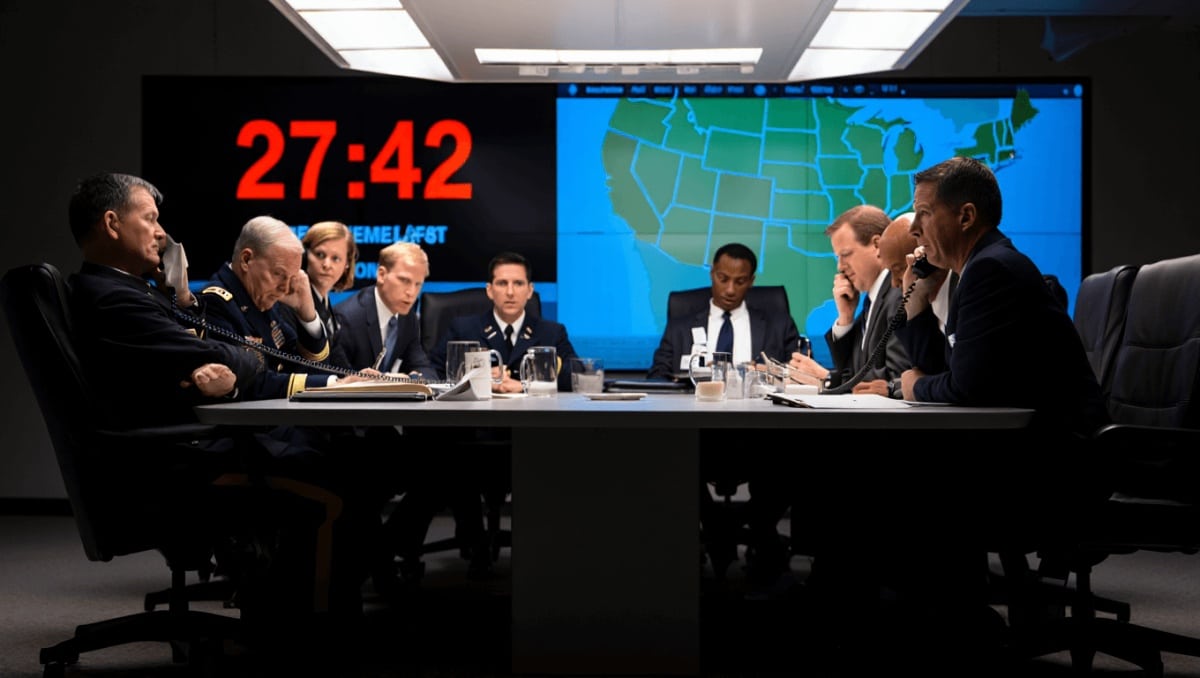
Much of the film unfolds on a high-stakes video conference linking the White House, the Pentagon and other agencies. Specialists in nuclear command praise the look and flow of those sequences.
The drama depicts designated conference calls that would assemble as a threat emerges. The layout of the Situation Room and underground command centers earned particular notice for authenticity.
The presidential “football”—the military satchel that travels with the commander in chief—appears as it should. The prop and the decision aides were realistic enough to convince former officials and scholars.
Human details: rule-bending under stress
Critics highlighted how the film shows officials behaving like real people. In private moments, they reach for cell phones or act emotionally. That human element resonated with experts who study how real personnel might deviate from protocol.
- Stress can push people to break rules or seek personal contact.
- Small human choices can have big consequences in crisis settings.
Missed options: a presidential choice the movie sidesteps
The movie frames a direct and immediate counterattack as the most obvious response. In practice, military doctrine and experts suggest a different calculus.
U.S. forces can launch on warning, but doctrine emphasizes a credible second-strike capability. That allows the country to retaliate even after suffering heavy damage. Waiting for attribution and fuller information is often a recommended path.
Some analysts said the film could have explored options such as delaying retaliation until intelligence confirmed the attacker. Attribution of nuclear material and forensic analysis can narrow responsibility in days, not minutes.
Timing and context: why the film matters now
Experts agreed the movie arrives at a moment when public attention to nuclear risk is low but geopolitical danger is rising. Major powers are modernizing arsenals and old arms-control frameworks are fraying.
- China, Russia and the U.S. are expanding and upgrading nuclear forces.
- Key treaties are expiring, creating new strategic uncertainty.
- Policy debates about missile defense, new weapons and deterrence have renewed urgency.
For arms-control advocates, the film is a prompt to debate what changes could reduce the chances of miscalculation or accidental escalation. A House of Dynamite pushes questions about deterrence, command choices and the systems designed to keep nuclear weapons from being used.
Where experts found value in the drama
Although commentators picked apart technical liberties, many said the film succeeds at its core aim: provoking public thought about nuclear risk.
- It makes invisible systems visible to a broad audience.
- It highlights difficult trade-offs leaders face under pressure.
- It puts procedural and moral dilemmas on display for debate.
Advocates for arms control hope the movie sparks conversations about reducing dangerous pathways to nuclear escalation. One observer urged viewers to ask what policy steps would lower the odds that a real-world crisis turns nuclear.










