
Show summary Hide summary
- How this version reinvents a familiar adventure
- Cast and characters that stand out
- World-building and visual design
- Plot moves fast but sometimes without feeling
- Writing: ambition vs. clarity
- Relationships that need more grounding
- Moments that work, and where they fall short
- Thematic threads left unravelled
- Who will enjoy this Treasure Island?
Robert Louis Stevenson’s seafaring tale returns in a lavish MGM+ remake that aims to reshape the old map. This Treasure Island leans hard into political unrest, human cost, and a reshuffled cast of motivations. It’s visually striking and theatrically performed, but the emotional core often feels incomplete.
How this version reinvents a familiar adventure
Creator Robert Murphy discards strict fidelity to the 19th-century text. He weaves in historical currents, including echoes of the Haitian Revolution, while recasting familiar faces. The show treats the novel less like a blueprint than a jumping-off point.
90s R&B: 3 artists who prove you have great taste
Drakeo the Ruler’s estate settles after fatal stabbing
- Major themes are amplified: rebellion, oppression, and survival.
- Characters are rearranged and given new backstories.
- Plot threads from the classic are mixed with real-world history.
Cast and characters that stand out
The performances are a central reason to keep watching. Several actors bring texture to roles that could otherwise be flat.

- David Oyelowo as Long John Silver: magnetic and quietly brutal, he injects the role with pain and tactical cunning.
- Hayley Atwell as Bess: a sharp, transactional single mother who uses charm like currency.
- Tom Sweet as Jim Hawkins: young and earnest, he carries the story’s coming-of-age thread.
- Tomer Capone as Billy Bones and Jack Huston as Graham: useful foils who add romantic and moral friction.
Oyelowo’s portrayal deserves particular notice. He transforms small gestures into emotional shorthand. Atwell supplies sly humor and a fierce practical streak. Together, they help the show feel alive at moments.
World-building and visual design
The production values are polished and tactile. Sets and locations rarely rely on obvious CGI. Costumes and interiors evoke a lived-in 18th-century world, from ornate manor houses to humid Caribbean coasts.
- Wide seascapes and dense jungles create a sense of scale.
- Attention to period detail keeps many scenes grounded.
- The cinematography favors texture over spectacle.
The show often looks beautiful, and that helps sell the stakes early on. For viewers who appreciate rich production design, this Treasure Island delivers.
Plot moves fast but sometimes without feeling
The series spans six hour-long episodes. It opens on Jim Hawkins running a tavern with his mother, scraping by and leaning on one odd talent: near-perfect recall.

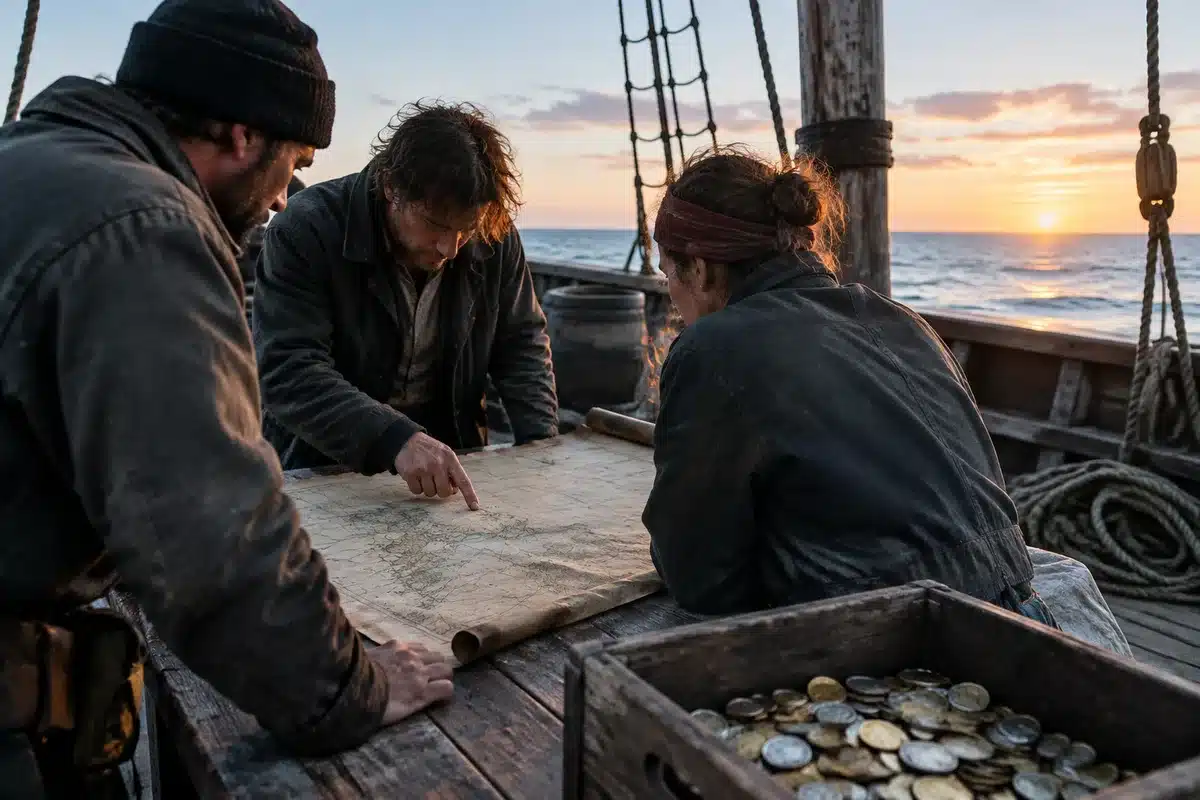
When a pirate named Billy Bones washes ashore with a treasure map, Jim and Bess are swept into a voyage toward fortune. A merchant named Graham hires the ship, and Long John Silver is soon aboard, hunting the same prize.
The narrative is packed with classic adventure elements: mutiny, jungle treks, a volcanic threat, and guerrilla-style clashes. The plot rarely slows for reflection. That keeps the pace brisk, but it also chips away at emotional investment.
Plot strengths
- Frequent action beats keep energy high.
- Political unrest gives the voyage a larger context.
- Unexpected tonal pivots (romance, intrigue) add variety.
Plot weaknesses
- Character motivations often reduce to gold obsession.
- Twists and betrayals pile up so fast they blur together.
- Moments that invite empathy are rarely explored fully.
Writing: ambition vs. clarity
The series is ambitious in concept but uneven in execution. It raises weighty ideas about power and freedom. Yet those ideas are frequently introduced and then abandoned.
The ensemble is defined by shifting loyalties. That choice adds intrigue but also produces emotional distance. When every line may hide ulterior intent, sincerity becomes scarce.
Motivations often feel simplistic. Many characters pursue treasure as if it explains everything about them. That turns complex people into plot devices.
Relationships that need more grounding
One central relationship is between Jim and his mother, Bess. On paper, this should anchor the series. In practice, the bond lacks texture.
- The show gives hints about Bess’s survival strategies.
- It shows Jim’s vulnerability and youth.
- But it rarely shows the small, lived-in moments that explain how those two shaped each other.
Without clear emotional beats between them, the parent-child thread never fully resonates. Young Tom Sweet tries to hold scenes together, but the material gives him limited space to grow.
Moments that work, and where they fall short
Several episodes feature vivid sequences: a brutal barroom collision, tense private conversations, and a daring escape that should spark heart-pounding tension. On paper, the ingredients for great television are there.
Yet many of these sequences land as repetitive or perfunctory. The stakes feel mechanical when viewers haven’t been given reasons to fear for these people.
- Strong scenes are often actor-driven rather than script-driven.
- Action set pieces are entertaining but occasionally draining.
- The series contains some disturbing imagery, though not gratuitous gore.
Thematic threads left unravelled
The show touches on slavery, displacement, and resistance. It grants Long John Silver a painful backstory and gives Bess moments of sharp social insight.
These moments suggest a series trying to engage with moral ambiguity. But larger thematic arcs are rarely connected to the plot’s daily machinations. That leaves questions unresolved.
Serious ideas appear, then drift away, which makes the political framing feel decorative rather than integral.
Who will enjoy this Treasure Island?
Viewers who respond to strong performances and high production values will find much to admire. Fans of historical drama with action and moral complexity may be drawn in.
- If you want elegant visuals and charismatic actors, this series delivers.
- If you need deep emotional payoff and tight plotting, it may feel unsatisfying.










