
Show summary Hide summary
- How a physicist reads a crowd: from applause to pressure maps
- Experiments that connect grains, animals and people
- When obstacles help — and when they don’t
- Pamplona as a living laboratory for crowd safety
- What the findings mean for crowd management and safety
- From research to real-world fixes: the road ahead
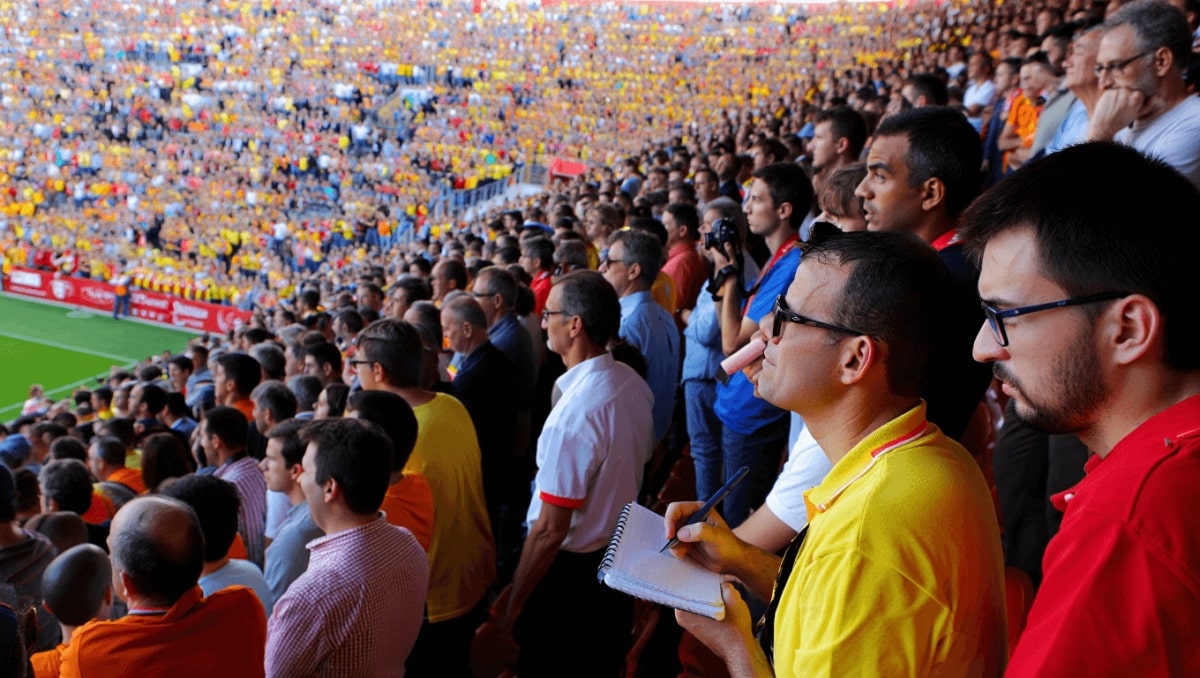
At a packed stadium in Pamplona, a single cheer can send thousands moving as one. Scientists watch those waves of people the way meteorologists watch storms. Their goal: decode crowd behavior to prevent injuries and save lives.
How a physicist reads a crowd: from applause to pressure maps
Iker Zuriguel, an applied physicist at the University of Navarra, studies how people flow when space tightens. He watches fans stream out of El Sadar after a soccer match. From a corner he can see natural lanes form, strangers following the same path to avoid collisions.
Nas slams music industry over disrespect: teases new music, vows to address it
1992 vocal performances: 3 jaw-dropping moments that still amaze
Those paths are not just social habits. At high densities, human choices give way to physical rules. Zuriguel explains that individual intent matters less when bodies press together. In dense crowds, forces and motion patterns emerge that resemble fluids or granular materials.
Experiments that connect grains, animals and people
Zuriguel began with tiny objects and simple setups. He borrowed methods from particle physics to explore how bottlenecks clog.
- He ran grains and ball bearings through narrow exits.
- He studied how adding an obstacle near the opening changed flow.
- He scaled up to living systems: sheep moving through doorways to feed.
Adding a small blocker above an outlet transformed behavior in surprising ways. With grains, what used to jam every few seconds ran continuously for minutes. With sheep, a concrete cylinder reduced the longest, most dangerous clogs by more than 90%.
Why a simple plank changed evacuation times
Past research showed a plank near a door could speed up an evacuation. That result sparked debate. Was the effect psychological or mechanical? Zuriguel’s layered approach—grains, sheep, then humans—sought to answer that question.
When obstacles help — and when they don’t
Experiments with inanimate and animal subjects suggested obstacles relieve pressure near exits. But human bodies add complexity. Zuriguel tested the idea with volunteer students, then with 200 soldiers performing full-force drills.
In the military trial the blocker produced no improvement. The difference appeared to be the intensity of pushing. When people shove hard, rotations and chaotic rotations emerge. Those shear forces can cancel the obstacle’s benefit.
Human shape and forceful behavior can override a device that helps inert particles.
Pamplona as a living laboratory for crowd safety
Zuriguel studies crowds in the city itself. He films the festival of San Fermín and the run of the bulls from balconies. The plaza he watches is smaller than an Olympic pool. Each morning, thousands gather there before the run.
Density rises until bodies press tightly. People can be lifted off the pavement by the mass. Yet decades of observation show no fatalities at that specific festival moment. Zuriguel and his team searched the footage for why.
Unexpected patterns in a chaotic square
The video revealed a repeating pattern. Individuals traced small loops the size of a car. These orbital motions repeated in cycles that averaged 18 seconds. When a band marched through and split the crowd, the cycles shortened to eight or nine seconds.
Those loops and the common orientation of people toward city hall may dampen dangerous pressure waves. Zuriguel believes that the group’s collective motion helps break up pushes that travel through the mass.
What the findings mean for crowd management and safety
- Obstacles can reduce jamming in some systems by lowering pressure at exits.
- Results depend on the actors: grains, animals, or people behave differently.
- High-intensity pushing can create rotations that negate obstacle benefits.
- Natural motion patterns in public spaces can limit the reach of pressure waves.
By mapping motion, timing, and force, researchers can design better venues and protocols. Zuriguel’s blend of laboratory work and real-world observation points toward practical changes in crowd control and event planning.
From research to real-world fixes: the road ahead
Zuriguel continues to test layouts and interventions. His experiments aim to translate physics into actionable measures for event organizers and city planners. Small changes in geometry or guidance could reduce the risk in packed gatherings.
Studying crowds as physical systems offers tools to prevent trampling and worst-case disasters.










