
Show summary Hide summary
- Studio practice: belts as material and message
- Key pieces that have resonated: “Watch Your Tone” and “Because I Love You”
- Historical context: from slavery to modern discipline
- Reaction online and in public: conversation, defense and catharsis
- Parenting, identity and creative intention
- Exhibitions, collectors and the road ahead
Lex Marie has turned a fraught family memory into a visual language that is drawing attention online and offline. Her canvases — sometimes lined with belts, sometimes struck with them like paintbrushes — force viewers to confront discipline, race and memory in intimate and public ways.
Studio practice: belts as material and message
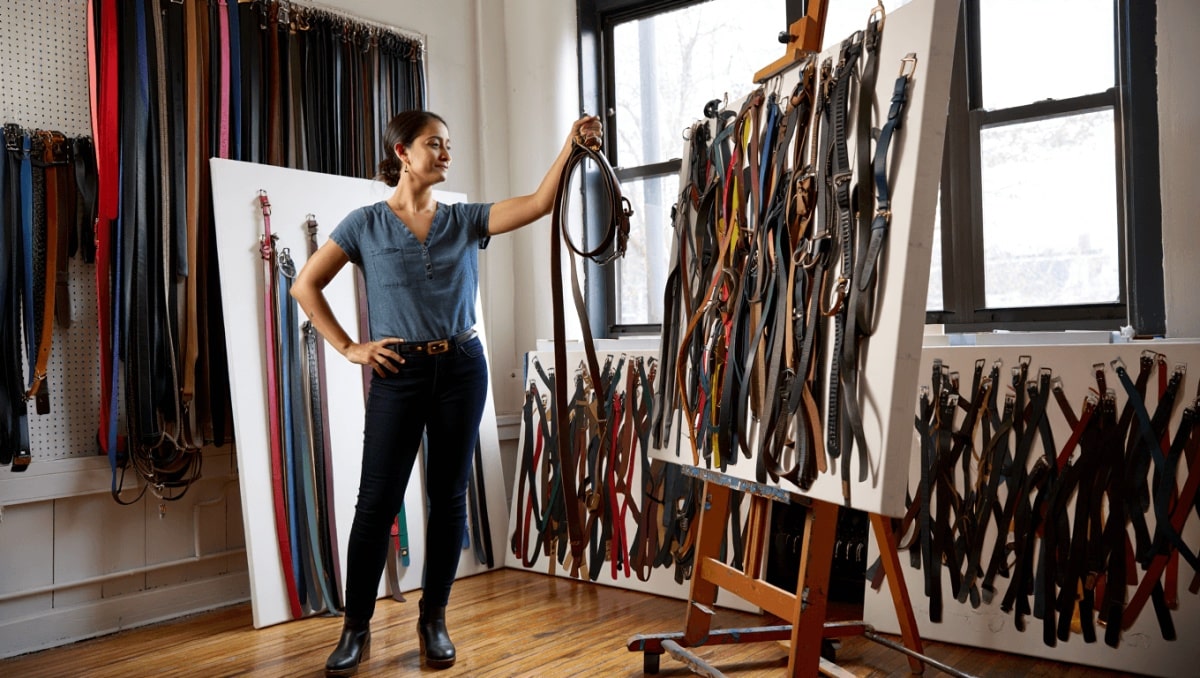
In her Washington, D.C. studio, Marie treats belts in two distinct ways. Some are arranged in precise grids across large canvases. Others are dipped in paint and swung to leave bold, serrated strokes.
Nas slams music industry over disrespect: teases new music, vows to address it
1992 vocal performances: 3 jaw-dropping moments that still amaze
Those opposing approaches produce different effects. The woven belts feel archival and deliberate. The painted whips are aggressive and immediate.
- Assemblage works feature rows of belts in varying tones to suggest skin and identity.
- Action pieces record the physical act of punishment through repeated paint strikes.
Marie describes the work as tied to memory, parenting and survival. She is 33 and the mother of an eight-year-old son. Her day-to-day experience as a parent often surfaces in the studio.
Key pieces that have resonated: “Watch Your Tone” and “Because I Love You”
Two works in the series have become focal points for conversation. “Watch Your Tone” is a six-by-six-foot panel covered with dozens of belts. Marie selected belts in a range of browns, black and pink to reference different skin tones and histories.
The title echoes a familiar parental command. The composition asks viewers to read the belts both as objects of punishment and as symbols of lineage.
In “Because I Love You”, Marie repeatedly struck a white-painted panel with a paint-dipped belt. The marks resemble welts, scattered and uneven, and the repetitive labor left the artist physically sore.
How the process feeds the meaning
Marie’s methods are intentional. The physical act of striking a canvas is part catharsis, part documentation. It allows trauma to be rendered as texture, shadow and rhythm.
She says the work is not meant to point fingers. Instead, it opens space for stories families rarely share out loud.
Historical context: from slavery to modern discipline
Scholars say discussions about corporal punishment in Black families cannot be separated from the country’s violent past. Practices used to control enslaved people left legacies that echo into familial discipline.
Experts argue a thread links the brutal control of enslaved bodies to later cultural norms about harsh discipline. Those systems hardened over generations and influenced how some parents enforced behavior.
One historian noted that the normalization of extreme physical punishment stemmed from a belief that Black bodies required stricter control. That belief mutated through time and took root in different institutions, including the home.
Why this matters now
As conversations about racial justice have grown louder, many are also reassessing everyday practices inside communities. The goal, some argue, is to replace punitive patterns with caring, restorative approaches.
Reaction online and in public: conversation, defense and catharsis
Marie’s videos on TikTok and Instagram gained swift traction. Thousands responded, sharing memories that ranged from painful to grateful.
- Some commenters defended corporal punishment as tradition.
- Others described long-term emotional wounds tied to spanking or whipping.
- Many used Marie’s work as a prompt to discuss alternatives to physical discipline.
Marie says the aim is not condemnation. She wants reflection. Her installations give language to people who may struggle to name their experiences.
Parenting, identity and creative intention
Motherhood reshaped Marie’s questions about her own upbringing. Watching her son grow prompted comparisons between how she was raised and how she wants to parent.
The work functions on multiple levels: it is personal therapy, public provocation and cultural critique. Through art, Marie explores how love, fear and discipline can be tangled together.
Exhibitions, collectors and the road ahead
Marie is expanding the series for a fall exhibition in Brooklyn. Nearly 20 pieces are in the collection so far, and a few have already been acquired by collectors interested in the project.
Her growing visibility — both among social media audiences and in gallery circles — reflects a demand for work that engages difficult histories and personal testimony.
Artists, curators and viewers continue to debate the ethics and implications of depicting corporal punishment. Marie’s work keeps that conversation visible and immediate.










