
Show summary Hide summary
- How the story unfolds: a wedding week unravels
- What breaks them: the confession that changes everything
- Perspective and editing: whose truth are we shown?
- Race, gender, and the film’s troubling undertones
- Performances that anchor the film
- Stylistic risks and narrative limits
- What stays with you after the screening
A24’s latest release, The Drama, arrives as a tense, image-driven probe of love, fear, and the fragility of trust. Director Kristoffer Borgli stages a modern wedding on the brink of collapse, using jolting flashbacks and nightmares to pry open a couple’s bond. The film pushes viewers into uncomfortable territory and asks which side of a partner you can really know.
How the story unfolds: a wedding week unravels
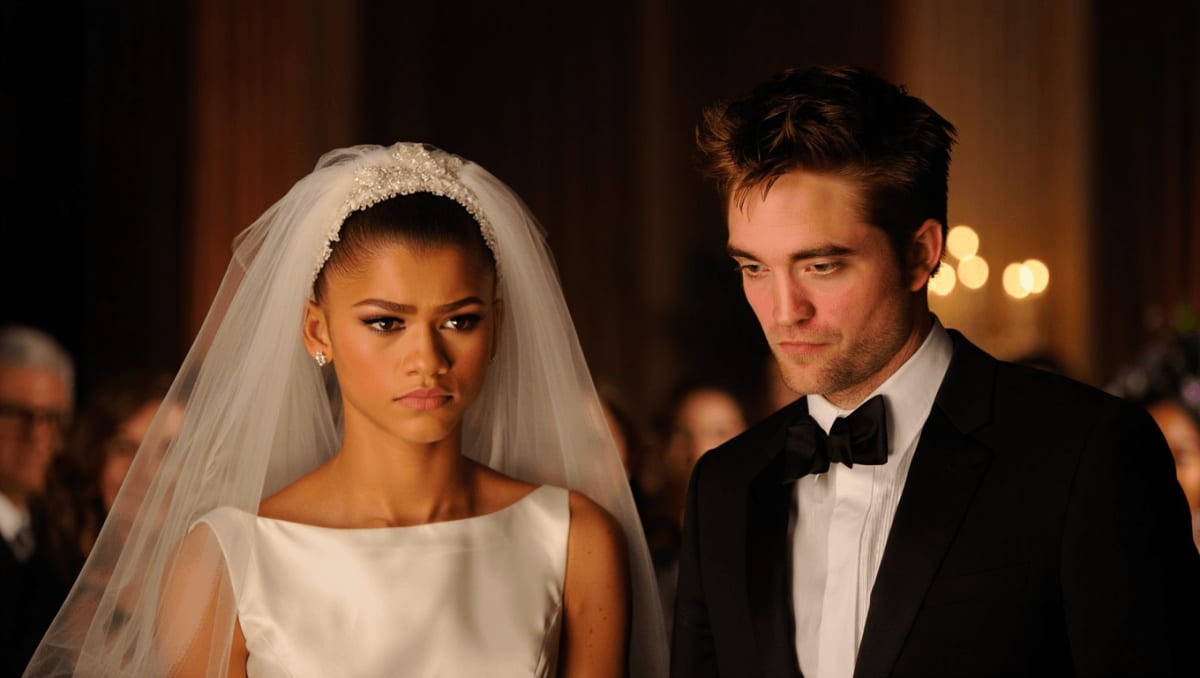
The film follows Charlie (Robert Pattinson) and Emma (Zendaya) in the days before their wedding. What begins as small anxieties grows into full-blown paranoia when a late-night confession detonates the couple’s future. Borgli slices the timeline into present moments, memory fragments, and vivid fantasies.
Nas slams music industry over disrespect: teases new music, vows to address it
1992 vocal performances: 3 jaw-dropping moments that still amaze
- Set-up: A meet-cute, courtship, and a ring on a finger.
- Trigger: A single revelation at a party reshapes perception.
- Escalation: Charlie’s imagination fills with violent visions that undercut trust.
What breaks them: the confession that changes everything
At a drinking game, Emma admits she once planned a school shooting but never carried it out. The disclosure shatters friendships and corrodes Charlie’s confidence. He begins to dismantle the woman he thought he knew.
Instead of a steady character study, the film leans into Charlie’s mounting obsession. He deletes compliments from his wedding speech, experiences intrusive images of Emma with a rifle, and envisions a massacre on their big day. The narrative becomes a descent into a single man’s spiraling doubt.
Moments the film returns to
- Childhood flashbacks of a lonely teen with access to a military rifle.
- Alternating views where Emma is both vulnerable and menacing.
- Imagined wedding-day atrocities that blur fantasy and fear.
Perspective and editing: whose truth are we shown?
The Drama begins with both partners’ voices. Midway, the camera and script tilt toward Charlie. His paranoia colors the film’s visuals, leaving Emma increasingly opaque. Viewers are nudged to align with his anxiety.
Borgli and editor Joshua Raymond Lee create restless energy through jump cuts and abrupt shifts. This kinetic style builds unease but also fragments Emma’s interior life. As a result, the film often feels like Charlie’s fever dream rather than a balanced portrait.
Race, gender, and the film’s troubling undertones
Beyond relationship drama, The Drama brushes against racial dynamics it rarely names. When the characters disclose their worst acts, Emma’s hypothetical violence provokes the strongest reaction, even as another character recounts actual assault.
The casting choices for Emma’s younger self introduce a painful subtext. The film contrasts different images of femininity and seems to tap into stereotypes about Black women without fully interrogating them. This creates an undercurrent of misogynoir that the script never resolves.
- Colorism appears in the portrayal of Emma at different ages.
- Charlie’s fear triggers racialized imagery linked to guns.
- Attempts at cultural commentary land shallowly and provoke questions.
Performances that anchor the film
Zendaya and Robert Pattinson bring palpable intimacy to scenes of early romance. Their chemistry is one of the film’s most persuasive elements. Zendaya balances warmth with an eerie distance when required.
Pattinson is willing to make his character look foolish and panicked. He surrenders to humiliation and mounting dread. Supporting turns — including Mamoudou Athie and Alana Haim — add texture, each actor sharpening awkward public confrontations and private fractures.
- Zendaya: Grounded, emotionally controlled, and haunting in imagined threat scenes.
- Pattinson: Imploding with embarrassment, rage, and comic timing.
- Supporting cast: Elevate small scenes, providing social texture and friction.
Stylistic risks and narrative limits
Borgli favors abrupt tonal shifts and surreal touches. The editing keeps the audience off balance, which suits the film’s exploration of anxiety. At times, the stylistic choices are powerful.
But the film’s focus narrows into a single paranoia loop. Emma’s voice grows distant, and the screenplay does not always justify its obsessions. What begins as an intriguing twist on “cold feet” becomes repetitive and occasionally tedious.
What stays with you after the screening
The Drama does not arrange tidy answers. Its finale leaves questions intact and invites multiple readings. The ambiguity can feel earned in places and unresolved in others.
The movie opens April 3 and will likely provoke debate over how films depict trust, race, and the role of imagination in romantic collapse.










