
Show summary Hide summary
The 1990s produced some of cinema’s most memorable music moments, blending film score craftsmanship with pop culture energy. From sweeping orchestral themes to curated song lists that captured a generation, these soundtracks changed how films connect with audiences. Below are five standout 1990s movie soundtracks that left lasting marks on charts, awards, and the cultural conversation.
The Lion King (1994): A New Standard for Animated Scores
Hans Zimmer’s work on The Lion King merged epic orchestration with African rhythms. Elton John’s songs gave the soundtrack broad commercial appeal. Together they turned an animated film into a global music phenomenon.
Nas slams music industry over disrespect: teases new music, vows to address it
1992 vocal performances: 3 jaw-dropping moments that still amaze
Key contributors and impact
- Composer: Hans Zimmer
- Songwriter: Elton John; Lyricist: Tim Rice
- Awards: Academy Award for Best Original Score; awards for songs
Standout tracks that defined the film
- “Circle of Life” — opening anthem that sets the emotional tone.
- “Hakuna Matata” — upbeat song that became a children’s classic.
- “Can You Feel the Love Tonight” — commercial single that topped charts.
The Lion King soundtrack sold millions and helped broaden the idea that animated films could compete on mainstream music charts.
Pulp Fiction (1994): How a Curated Playlist Became Iconic
Quentin Tarantino’s Pulp Fiction used music like a narrative device. The soundtrack mixed surf rock, soul, and pop. It didn’t rely on a single composer but on careful song selection.
Why the soundtrack stands out
- Eclectic mix: 1960s surf rock, ’70s soul, and modern covers.
- Character-driven music: Songs enhance scenes and dialogue.
- Cultural impact: Reintroduced older tracks to new audiences.
Memorable tracks and moments
- “Misirlou” — a blazing opener that became synonymous with the film.
- “You Never Can Tell” — the dance scene that revived a classic.
- “Son of a Preacher Man” — uses contrast to deepen tension in a scene.
Pulp Fiction’s soundtrack proved that song selection can be as powerful as original scoring.
Trainspotting (1996): A Soundtrack that Captured a Generation
Trainspotting paired Danny Boyle’s kinetic filmmaking with a soundtrack full of Britpop and electronic acts. The music reflected the film’s urban grit and youth energy.
Contributors and cultural resonance
- Artists: Iggy Pop, Underworld, Blur, Lou Reed
- Sound: Alternates between pulsing electronic tracks and raw rock.
- Effect: Cemented the link between British cinema and contemporary music.
Tracks that defined a mood
- “Lust for Life” — Iggy Pop’s driving opener sets a rebellious tone.
- “Born Slippy .NUXX” — Underworld’s anthem that became synonymous with the film.
- “Perfect Day” — Lou Reed’s cover used to powerful, ironic effect.
Trainspotting’s soundtrack helped launch or relaunch several tracks and artists in the mid-90s music scene.
Titanic (1997): Epic Score Meets Global Pop Success
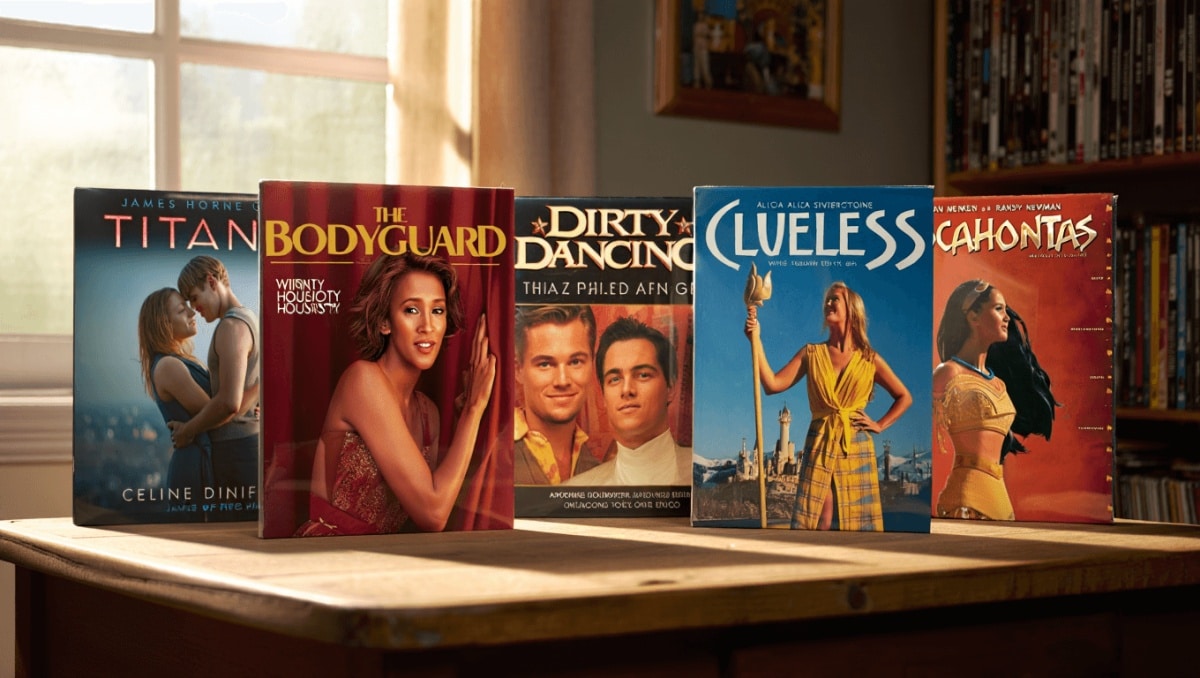
James Horner’s sweeping orchestral score for Titanic paired with Celine Dion’s ballad to create one of the decade’s biggest musical moments. The soundtrack sold widely and became inseparable from the film’s romance and tragedy.
Elements that drove success
- Composer: James Horner
- Hit single: “My Heart Will Go On” performed by Celine Dion
- Accolades: Academy Award for Best Original Song and multiple chart-topping placements
Tracks and emotional peaks
- “My Heart Will Go On” — crossover pop hit that dominated radio.
- “Southampton” — orchestral piece that opens the voyage.
- “Rose” — themes that underscore the film’s intimacy.
Titanic’s soundtrack showed how a film score and a single mainstream song can combine to create worldwide appeal.
The Matrix (1999): Electronic Edge and Orchestral Power
The Matrix introduced audiences to a hybrid musical approach. Don Davis handled the score’s orchestral backbone. Industrial, techno, and rock tracks added a contemporary, aggressive edge.
Why the soundtrack mattered
- Composer: Don Davis
- Genres fused: Orchestral score with industrial, electronic, and metal tracks
- Legacy: Influenced late-90s and early-2000s film music aesthetics
Notable songs and score moments
- “Clubbed to Death” — a moody electronic piece used in key scenes.
- “Spybreak!” — propulsive track for the lobby action sequence.
- Orchestral cues — tense, rhythmic motifs that support the film’s ideas.
The Matrix soundtrack set a template for combining electronic music with classical scoring in blockbuster films.










