
Show summary Hide summary
- Why staff say they were forced to strike
- Who is on strike and how many people are affected
- What the union wants: top demands and priorities
- How the strike affects WGA operations and upcoming negotiations
- Picket lines, public protest and the visuals on Fairfax
- Negotiation timeline and what each side says
- Public documents and transparency efforts
- Support from other unions and industry reactions
- What employees say about the strike’s duration and morale
- Background: how the staff union formed and where talks began
The staff of the Writers Guild of America West walked off the job Tuesday, accusing union management of unlawful conduct and launching a work stoppage that could complicate Hollywood’s contract season. The move, driven by disagreements over bargaining tactics and employee protections, unfolded just weeks before the WGA prepares to face studios in talks that shape writers’ pay and working terms.
Why staff say they were forced to strike
Employees represented by the staff union claim management committed multiple unfair labor practices. The staff union alleges a pattern of behavior that includes monitoring union activity, firing supporters and stalling negotiations.
Nas slams music industry over disrespect: teases new music, vows to address it
1992 vocal performances: 3 jaw-dropping moments that still amaze
Those allegations led the Writers Guild Staff Union (WGSU) to call an unfair labor practice strike. The union argues management has not seriously engaged on core contract demands.
Who is on strike and how many people are affected
The walkout impacts roughly two-thirds of WGA West’s staff. About 100 of the union’s 150 or so employees are part of the action.
The striking workers are organized under the Pacific Northwest Staff Union and had authorized a strike after talks failed to reach agreement.
What the union wants: top demands and priorities
- Just-cause protections for discipline and layoffs.
- Seniority rights to protect long-serving staff.
- A reworked wage scale and stronger pay protections.
- Formal safeguards against surveillance and anti-union retaliation.
Staffers say pay remains a pressing issue: the union reported that a majority of members earn under $84,850 annually.
How the strike affects WGA operations and upcoming negotiations
The timing is sensitive. Contract talks between the WGA and the Alliance of Motion Picture and Television Producers (AMPTP) are scheduled to begin soon.
WGA West leadership said bargaining over the AMPTP deal will largely proceed, noting key executive staff working directly with the negotiating committee will not be on strike.
- WGA headquarters in Los Angeles closed to members and the public.
- Screenings at the Writers Guild Theater suspended.
- Internal briefings for writers on negotiation priorities were canceled.
- The annual WGA awards, set for March 8, had no official update on plans.
Despite those assurances, staff warned that some essential functions—like dues processing and residual payments—require experienced employees. They questioned how middle managers alone could handle all tasks.
Picket lines, public protest and the visuals on Fairfax
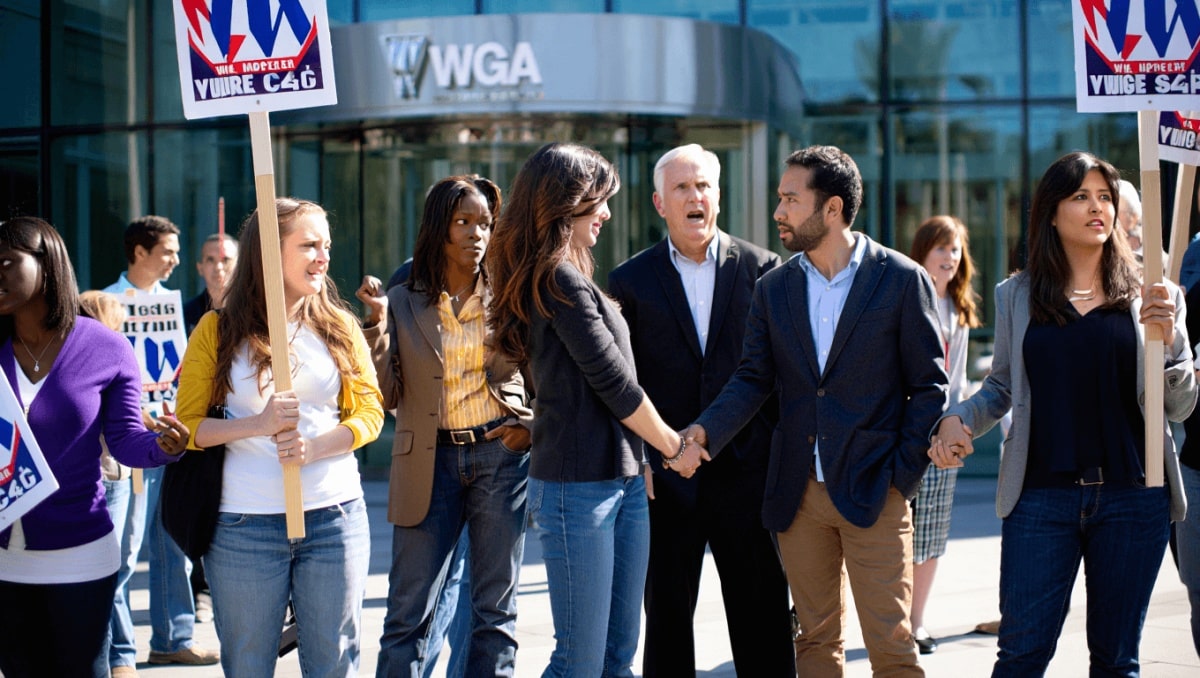
Staff began picketing outside the WGA West offices Tuesday afternoon. Demonstrators carried messages calling out poor bargaining and urging the guild to live its labor values.
A large inflatable rat, a familiar symbol at labor fights, was positioned near 3rd Street and Fairfax to draw attention to the action.
Negotiation timeline and what each side says
Staff union perspective
WGSU leaders said attempts to find common ground broke down after many bargaining sessions. Members report feeling ignored during later talks.
The staff union also filed an unfair labor practices charge with the National Labor Relations Board last August and has protested the firing of three employees.
WGA West management response
WGA West denies the claim of bad-faith bargaining and says it has repeatedly offered detailed proposals to improve compensation and working conditions.
The guild maintains the unfair labor practice claims lack merit and says management will continue to prepare for studio negotiations.
Public documents and transparency efforts
Both parties have published comparative charts of their positions. The staff union released its version, and the guild posted a side-by-side comparison to clarify differences.
These documents aim to show where proposals align and where gaps remain.
Support from other unions and industry reactions
Employees at WGA East, represented by a different union, issued a statement backing their West Coast colleagues. The New York staff union urged management to return to the table and bargain fairly.
Industry observers noted the strike adds a new front to labor tensions in entertainment, coming on the heels of recent high-profile labor disputes.
What employees say about the strike’s duration and morale
Staffers said they are prepared for a prolonged action. Many described the walkout as a collective leap of faith taken with fellow coworkers.
Organizers emphasized that unity and mutual support are helping sustain morale during the uncertainty.
Background: how the staff union formed and where talks began
The staff union organized last spring and opened first-contract negotiations in September. Union leaders said they expected a faster path to an agreement.
Negotiators met repeatedly over several months but ultimately reached an impasse over core protections and compensation structures.










