
Show summary Hide summary
- How the Houston program connects music, community, and NASA
- What students learned during the eight-week STEM course
- Student projects that bridged classroom ideas and space-aged solutions
- Voices on the collaboration: artists, educators, and space leaders
- Why local STEM programs like this matter for Houston students
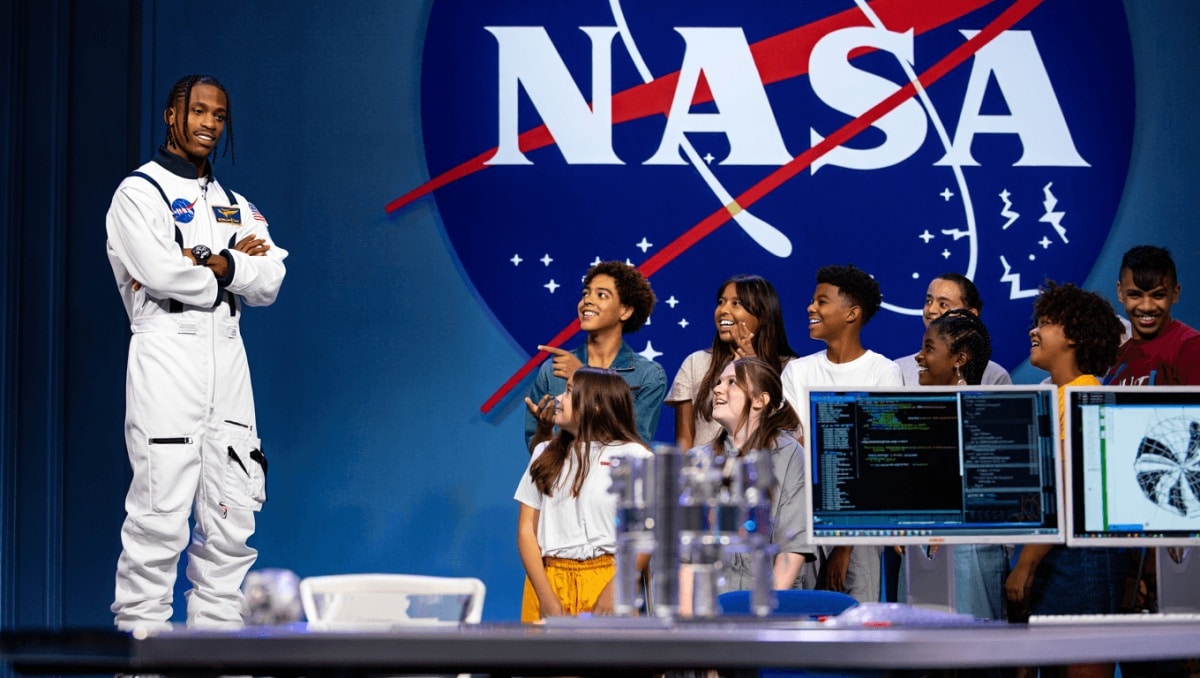
Travis Scott’s Cactus Jack Foundation has launched a new partnership with NASA and Space Center Houston to give Houston students a hands-on path into STEM. The program pairs local youth with engineers and educators for an intensive eight-week experience. It’s meant to spark curiosity and point students toward careers in science and engineering.
How the Houston program connects music, community, and NASA
The initiative grew from Cactus Jack’s education efforts in Travis Scott’s hometown. Space Center Houston joined the foundation to provide access to real-world space science. Students met with NASA engineers and worked inside the Cact.Us Design Center and Space Center Houston facilities.
Nas slams music industry over disrespect: teases new music, vows to address it
1992 vocal performances: 3 jaw-dropping moments that still amaze
The goal is simple: show young people the tools and processes behind design and exploration. Program leaders say it also aims to broaden who sees themselves as future scientists and makers.
What students learned during the eight-week STEM course
The curriculum combined theory with hands-on practice. In short modules, students picked up technical skills and creative problem solving.
Core elements of the curriculum
- Design thinking and prototyping
- Basic and applied coding for robotics and control systems
- Fabrication methods using modern tools
- Team-based engineering challenges
Mentors from NASA guided the students through each stage. The approach emphasized iteration and practical testing over lectures.
Student projects that bridged classroom ideas and space-aged solutions
At the program’s finale, participants presented projects aimed at real problems a lunar mission could face. The displays ranged from mechanical builds to habitat concepts.
- Lunar water filtration system — a prototype to recover and purify water in a low-gravity setting.
- Moon rover concept — a vehicle design focused on mobility and payload handling.
- Food-preserving habitat structure — a shelter concept that protects supplies and extends shelf life.
Engineers and educators evaluated the work, and the students explained their design choices and test results.
Voices on the collaboration: artists, educators, and space leaders
Representatives from the foundation and Space Center Houston spoke about the partnership’s intent. Travis Scott’s foundation framed the work as creating new career pathways for local youth. Foundation staff described the collaboration as a dreamed-for opportunity to tie community programs to cutting-edge science.
Space Center Houston’s leadership echoed that sentiment, emphasizing the city’s role in nurturing future problem solvers. NASA-affiliated staff joined the students at the final showcase to offer feedback and encouragement.
Why local STEM programs like this matter for Houston students
City-based programs remove barriers that often keep students from exposure to technical fields. By locating training in Houston, the initiative reduces travel and access hurdles.
- Hands-on mentorship connects students to career pathways.
- Early exposure to engineering tools builds confidence.
- Collaborations between nonprofits and science institutions magnify resources.
Organizers say this pilot is the start of broader efforts to create sustainable STEM opportunities across the region.











