
Show summary Hide summary
- Why The Bear comparisons keep surfacing
- How the film stages the creation of Nebraska
- Flashbacks and family history: thinly sketched trauma
- When the movie tries to show depression, it often tells instead
- Character drama and the romance subplot lose shape
- Jeremy Allen White’s performance is the film’s strongest asset
- Music, production design, and supporting performances
- What works, what doesn’t — quick takeaways for viewers
- Release details and festival premiere
Watching Springsteen: Deliver Me From Nowhere often feels like seeing a musical cousin to The Bear. Jeremy Allen White anchors both, but Scott Cooper’s biopic aims to probe the making of Nebraska and the private storms behind the songs. The movie mixes concert electricity with somber domestic flashbacks, and it asks whether this portrait brings us any closer to the man behind the myth.
Why The Bear comparisons keep surfacing
Jeremy Allen White’s presence makes the link immediate. Still, the echo runs deeper than casting. Cooper frames Bruce as a driven artist with a fraught family past and a hunger for perfection.
Nas slams music industry over disrespect: teases new music, vows to address it
1992 vocal performances: 3 jaw-dropping moments that still amaze
- Both leads are haunted by their ambitions.
- Both struggle to hold relationships together.
- Both films lean into the language of burnout and obsession.
The result is a tone that will feel familiar to fans of White’s recent work. But Cooper’s vision tries to fold Springsteen’s music and backstory into a somber character study.
How the film stages the creation of Nebraska
Deliver Me From Nowhere centers on the genesis of Springsteen’s sixth record. The film begins after fame has arrived, then follows a small window where songs are written and recorded.
Cooper uses clear, literal beats to show inspiration turning into music. Scenes include:
- Concert footage that captures the roar of a sold-out show.
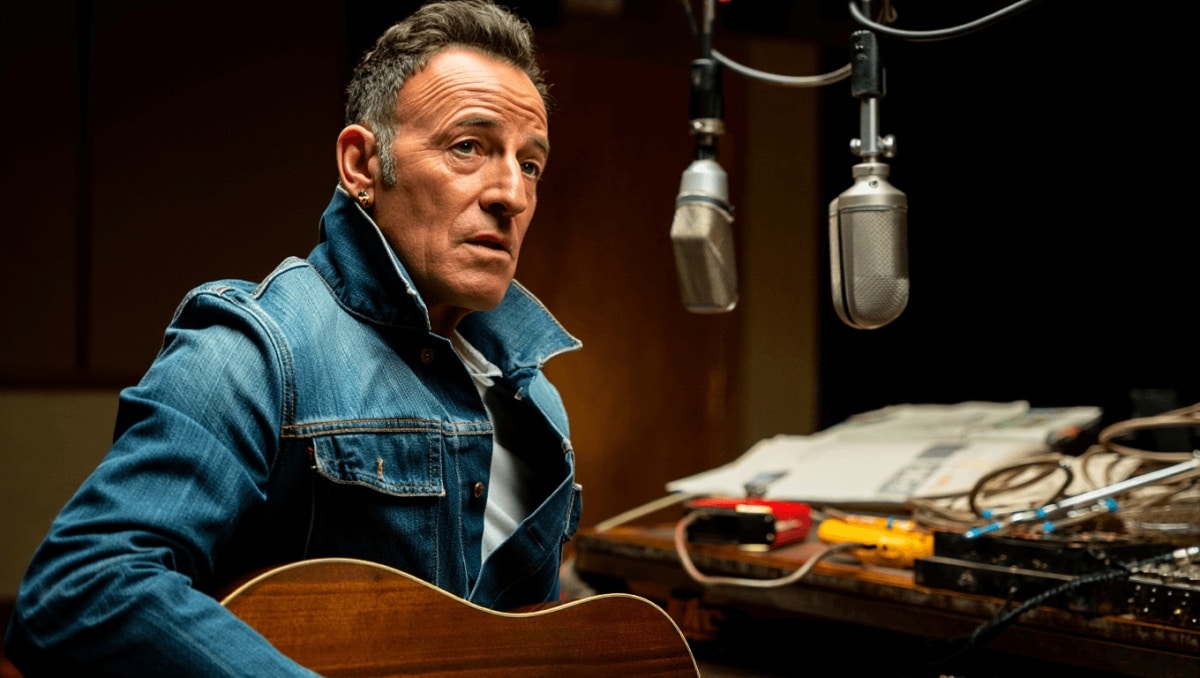
- Late-night recording sessions that foreground raw performance.
- Research and cinematic sparks, like watching Badlands, that trigger songwriting.
These sequences deliver the film’s most vivid energy. The studio and stage moments supply a musical heartbeat the rest of the film often misses.
Flashbacks and family history: thinly sketched trauma
The biography leans on childhood memories to explain adult unease. Those scenes are shown in grainy black and white and focus on an abusive father and a worried mother.
The problem is how the film treats these beats. The father is reduced to cigarettes and beer. The mother fits a familiar template. Their fights feel generic rather than revealing.
Because those formative moments are underwritten, the film struggles to make Springsteen’s later choices feel earned.
When the movie tries to show depression, it often tells instead
Cooper relies on classic visual shorthand for sadness: pacing, long silences, a car driven too fast. The film signals despair repeatedly.
But the motivations behind that despair are not fully shown. The script describes guilt and shame about the Nebraska songs, yet the recording scenes rarely expose what those feelings cost him.
Instead, the film presents a linear chain of inspiration: watch a movie, read a story, write a song. This approach leaves emotional gaps.
Character drama and the romance subplot lose shape
Springsteen’s relationship with Faye, played by Odessa Young, is meant to humanize him. Early moments try for warmth, but dialogue often slides into sentimentality.
The decision for distance feels plotted rather than felt. Confrontations meant to crack the character open sometimes land as familiar beats borrowed from other contemporary dramas.
Jeremy Allen White’s performance is the film’s strongest asset
White disappears into the role with a mixture of restraint and intensity. He adopts Springsteen’s vocal cadence and a weathered silence.
Where the screenplay falters, White often supplies the missing depth. His concert work is committed, even if his timbre does not perfectly match the Boss.
His quiet scenes are the film’s emotional anchor. A sequence of private grief, rendered without fuss, proves his capacity to carry heavy feeling.
Music, production design, and supporting performances
The film benefits from high-energy concert staging and focused studio interiors. Those moments convey why Springsteen became a live force.
- Stage scenes are visceral and sweaty.
- Studio sequences show craft and obsession.
- Jeremy Strong, Gaby Hoffmann, and Stephen Graham fill out the cast with reliable turns.
Yet the supporting roles sometimes remain outline sketches, offering function more than full interior life.
What works, what doesn’t — quick takeaways for viewers
- Work: Powerful lead performance and evocative concert scenes.
- Weakness: Simplified trauma and explanatory plotting.
- Note: Fans of Springsteen’s music will appreciate the songs on display.
Release details and festival premiere
Deliver Me From Nowhere screened at the New York Film Festival. The movie opens in theaters on Oct. 24.










