
Show summary Hide summary
Broadway has a new sensation: The Lost Boys has arrived as a bold, music-driven stage show that mixes teen longing, vampire myth, and striking spectacle. The production has become a frontrunner at this year’s Tony Awards and is drawing packed houses with its mix of emotion and showmanship.
From cult film to a fresh Broadway musical adaptation
What began as a cult-classic 1980s movie found new life onstage. A creative team led by director and co-lighting designer Michael Arden reimagined the story with a modern theatrical voice. They kept the film’s key moments but reshaped the narrative to fit a live, musical format.
Nas slams music industry over disrespect: teases new music, vows to address it
1992 vocal performances: 3 jaw-dropping moments that still amaze
- Core inspiration: the film’s mood and iconic beats.
- New approach: amplify themes and deepen character arcs.
- Musical backbone: original songs by the band The Rescues.
Translating screen moments into theatrical ones required invention. Scenes that worked on film were retooled so they land emotionally onstage. The creative team balanced nostalgia with original theatrical grammar.
Rewriting family dynamics to add weight and motive
The stage adaptation introduces a darker, more personal backstory for the Emerson family. The play centers on a mother and her two teenage sons who have moved to a new town to escape an unseen threat at home.
This added domestic conflict explains the family’s choices and fuels character tensions. The eldest son’s anger and search for belonging drive him toward the vampire leader. The vampires’ own violent impulses are given psychological roots, increasing the stakes.
Giving women fuller roles and new musical moments
The musical expands the female characters who were less developed in the film. Lucy and Star gain more agency and emotional depth.
- Lucy: a complex mother whose past choices shape the family’s present.
- Star: moved from decorative role to a voice that questions power.
The Rescues supplied a score that builds those perspectives into the show. Songs let women speak new truths. One number explores Lucy’s desire to reclaim youth. Another gives Star a powerful anthem about being shaped by others’ violence.
These songs operate on two levels: they advance the story and comment on our cultural moment.
Making queer identity central and visible
The musical removes ambiguity around certain relationships and turns subtext into clear emotional narrative. A coming-of-self arc for one of the Emerson boys is celebrated in a joyous, colorful musical number that reframes difference as strength.
Casting choices also push inclusivity. One of the Frog Brothers is played by a woman, which opens new questions about gender roles in the 1980s setting. The production treats identity as both personal and social, without forcing modern labels into period dialogue.
- Queer themes: made explicit in song and staging.
- Gender casting: rethinks classic character types.
- Found family: emphasized as a core emotional payoff.
The show turns outsider status into a unifying force. Characters bond over feeling out of place, and that shared sense of not belonging becomes the engine of connection.
Crafting the aerial spectacle: how the vampires fly
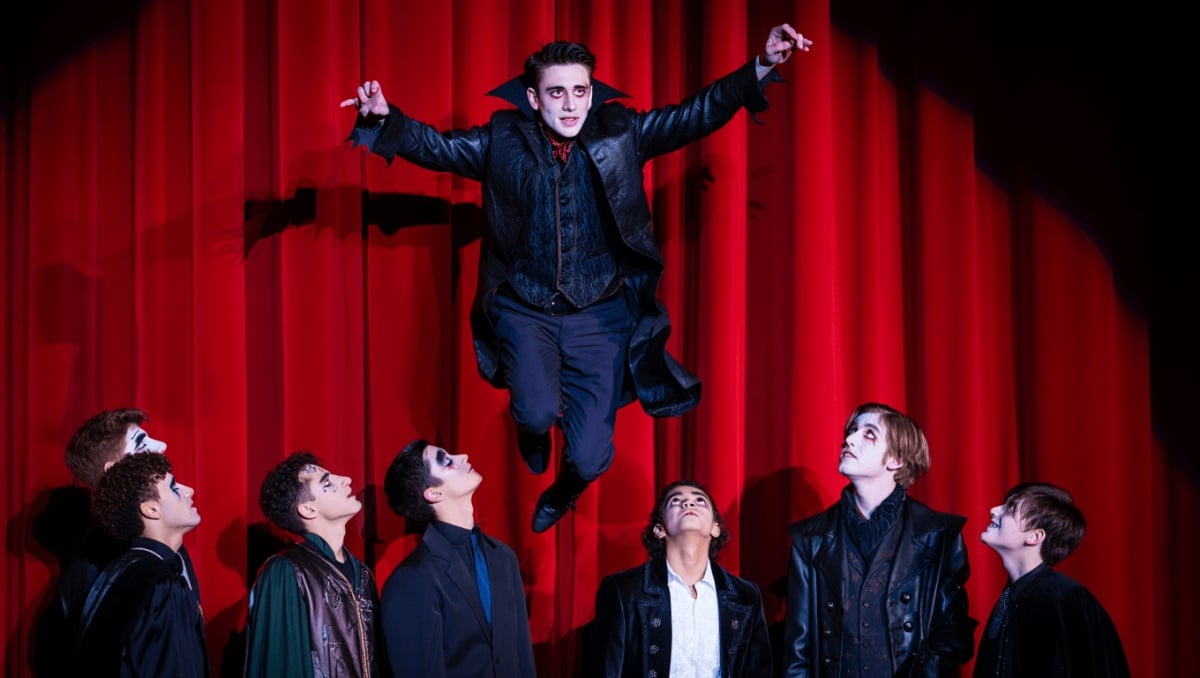
One of the production’s signature achievements is its flight work. The creative team needed to make airborne movement feel magical and emotionally charged.
They developed a custom rig and trained the cast to move naturally in the air. Auditions required performers to sing, act, and learn to fly. Rehearsals included intensive wire work to ensure fluidity and safety.
- Custom-fabricated flying system.
- Rig testing away from the Broadway stage.
- Physical training so flying reads as feeling, not trickery.
The goal was clear: make flight feel spiritual and beautiful, not just technical. That quality lets audiences accept the vampires’ terrifying power and their strange allure.
Music, staging, and awards momentum
The show has captured attention with its songs, staging, and performances. Critics and audiences alike have praised the score and the way the production balances spectacle with intimate moments.
- Major recognition: multiple Tony nominations, including Best Musical.
- Standout elements: vocal performances, choreography, inventive lighting.
- Box-office lift: strong ticket sales and sustained audience buzz.
Performances combine theatrical craft with cinematic references. The result is a production that respects the original film while staking out its own creative territory.










